


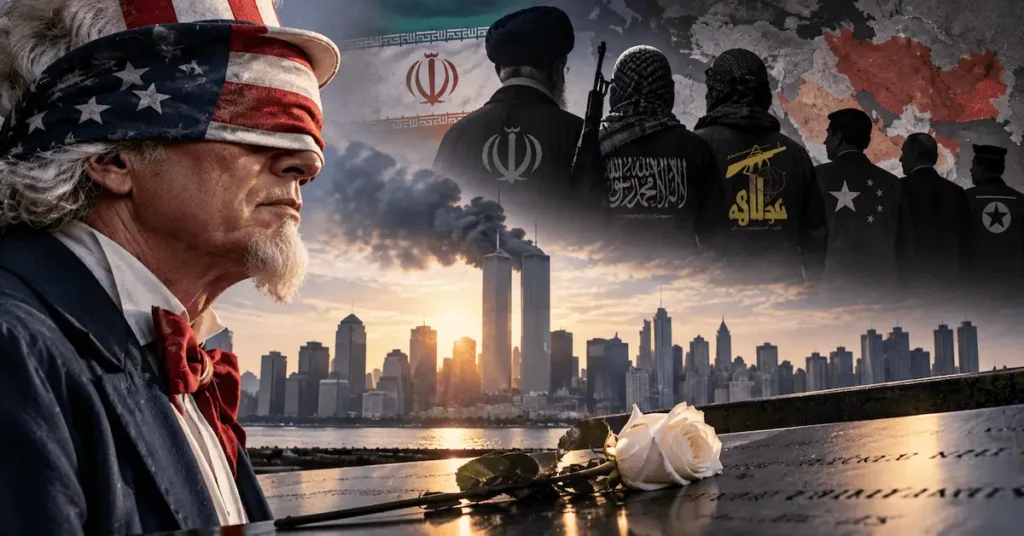
America’s 250th birthday celebration harkens back to our nation’s founding in 1776. It’s fitting to reflect on our two and a half centuries of history, with a special focus on September 11th in America’s past, given that our think tank, Near East Center for Strategic Engagement, was also founded on September 11, 2014, as a response to the watershed events of September 11, 2001.
Although three locations in America were the sites of the infamous terrorist attacks that occurred 25 years ago on September 11th, the most prolific losses occurred in Manhattan at the World Trade Center’s Towers (WTC) One and Two. All other WTC towers suffered total or catastrophic damage, including WTC 6, which was demolished and whose footprint became the site of the current One World Trade Center, or Freedom Tower, which has a symbolic height of 1,776 feet in acknowledgment of America’s year of independence. This building opened on Nov. 3rd, 2014.
Looking back 250 years to the time of the Declaration of Independence, the future site of the World Trade Center Towers encompassed approximately 16 acres of marshy or flooded ground. Ship wharves were located nearby on the banks of the Hudson River, which were populated mainly by oyster/spat collectors. In fact, attesting to the notion that the WTC site was once on or near the bed of the Hudson River, a 50-foot gunboat and various artifacts were found during the new Freedom Tower excavations at a depth of about 22 feet beneath landfill sediment. According to Peter Fix, a watercraft conservator at Texas A & M University involved in the conservancy project, the ship is thought to have been stationed outside the New York City area, defending Delaware Bay and the Delaware River from the British (quoted in Smithsonian Magazine). British forces may have captured it at some point, since a pewter button with the number 52 (possibly signifying the British Army’s 52nd Foot Regiment) was found in the vessel. The discovery underscores a poignant detail: the World Trade Center site was built over a reminder that America was waging its war of independence in 1776. Twenty-five years ago, as well as two hundred and fifty years in the past, two enemies of America expected our nation to submit and remain subjugated and conquered.
Beyond the plain fact that a nascent United States was at war, what was specifically happening on September 11, 1776, in New York, a mere 21 miles (as the crow flies) from the present 9/11 Ground Zero site, was that a fledgling American nation had recently suffered defeat in the Battle of Long Island. Fortunately, General George Washington had successfully evacuated 9,000 Continental troops across the East River 12 days earlier, on the night of August 29-30, 1776. The evacuation was conducted under cover of darkness and a thick morning fog, which many involved regarded as miraculous. A short time later, on September 11, 1776, “peace talks” with Great Britain, known as the Staten Island Peace Conference, were held at Billops Manor in Tottenville, Staten Island. Admiral Lord Richard Howe (a British peace commissioner with limited authority) sought talks to end the war and sent captured American General John Sullivan to convey his interest in a negotiated settlement to the Second Continental Congress. The Congress appointed Benjamin Franklin, John Adams, and Edward Rutledge to meet Howe—not as private individuals but as official delegates—to assess any proposals.
The three founding fathers crossed from patriot-held Perth Amboy, New Jersey, under a flag of truce. They were received courteously at the stone manor owned by Loyalist Colonel Christopher Billop, a recently used British barracks location, and for three hours discussed Howe’s proposal to grant pardons to those who submitted to the Crown and King to assure the subjugated that Britain was inclined to address colonial grievances and reform its administration of the rebellious colonies. He was not apt to recognize the American independence or deal with Congress officially, which had declared independence less than three months earlier.
The three founding fathers insisted that independence was non-negotiable and that any serious talks required the King’s recognition. The three delegates did not seek forgiveness but recognition of America as a sovereign and free nation. The Americans returned and reported to Congress that Howe offered nothing beyond unconditional submission. The conference delayed British operations only briefly; fighting resumed, and the war continued for another seven years.
The result of the September 11, 1776, peace initiative was the reality that America’s only path to final independence lay in nothing less than victory on the battlefield and at sea over the Crown and King.
Two hundred and twenty-five years later, America found itself at an oddly similar crossroads to 1776, when Great Britain expected the rebellious colonies to admit their wrongdoing and seek a royal pardon — in a word, total submission to a King.
In 2001, Bin Laden’s 19 Islamic militants of Al Qaeda carried out their attack on the US. So why are these two events even remotely similar? In a word: both entailed America’s submission to an external power and one man and the dictatorial system that demanded full subjugation of all living under the flag and banner of the King in 1776 or Islam in 2001. In 1776, Britain, led by King George III, was the external power. In 2001, the external power was the global Ummah, or the followers of Islamic dictates that Mohammed had coined as unquestionable religious doctrine. In both instances, the external threat was both “over there” and living here in America.
In his 2002 Letter to the American People, after ordering the murder of 2,977 free-minded Americans, Osama Bin Laden stated that his reasons for going to war with the US were based on America’s supposed role in “oppressing” the global Ummah; meaning we did not submit to what Mohammed had coined as religious doctrine. Thus, at the very beginning of his Letter to the free American People using a sword, Osama bin Laden provides, in the clearest terms, an exemplar of Islam’s perennial Muslim vs. infidel calculus. In effect: “In the Name of Allah, the Most Gracious, the Most Merciful,
“Permission to fight back (against disbelievers) is given to those
(believers) who are fought against…”, [Quran 22:39]. The surah continues: “…for they have been wronged.”
In his letter justifying the attacks against America, Bin Laden presented a laundry list of “offenses” he claimed America inflicted on Muslims, and among those items is something close to home and tied to our nation’s founding-truly a curious “beef”: “You are the nation who, rather than ruling by the Shariah of Allah in its Constitution and Laws, choose to invent your own laws as you will and desire. You separate religion from your policies, contradicting the pure nature which affirms Absolute Authority to the Lord and your Creator.”
In 1776, we had to submit to Britain and its crown as subjects; in 2001, we were excoriated for not submitting to Shariah law and to what is believed to be law given to a man by “god.”
Our US Constitution simply didn’t pass muster with Osama Bin Laden because it contradicted what he believed to be the word of a “god.” He also believed he was smarter than billions of people worldwide who reject and will continue to reject those dictates of Islam. He decided to wage war. To him, it was better to murder people who refuse to believe what he presented as “god’s” word than to allow them, on their own merit, to read and see if they agree with those dictates.
Rebellion against British rule on September 11, 1776, and defiance of the pretensions of Islamic hegemony on September 11, 2001, were both deemed causes of war to enforce the King and Osama’s will on free-thinking, educated, and common-sense Americans who rejected their ideology and fought against their subjugation.
First, the British, then the Islamic leaders, found our trait of being unmanageable insufferable for people who cannot survive without a willing people to subjugate themselves to their rule or what they call “religious theology.” Interestingly, our conflict with the dictates of Islam dates to the late 1780s, shortly after the Treaty of Paris in 1783, which recognized America’s independence. That independence meant American merchant marines were no longer shielded from Muslim corsairs because the U.S. was no longer protected by the British flag, and Britain was, at the time, paying tribute, or a jizya (Islamic tax), to the Barbary states in the Mediterranean. Thus, on October 11, 1784, the American merchant brigantine Betsey was captured by Moroccan Muslim corsairs.
This harassment of American merchant crews and the seizure of our merchant ships baffled our leaders. After more American vessels—the Maria and Dauphin were seized by Barbary pirates in 1785 and their crews enslaved, Thomas Jefferson and John Adams—America’s ambassadors to France and England, respectively—met with Tripoli’s ambassador to Britain, Abdul Rahman Adja, to try to ascertain why the Barbary States were hostile to a non-threatening independent America and to obtain the release of its citizens they had captured. What followed was a letter to Congress based on the conversations with Ambassador Rahman and his response:
“We took the liberty of making some inquiries concerning the grounds of their [Barbary’s] pretensions to make war upon nations who had done them no injury, and observed that we considered all mankind as our friends who had done us no wrong and had given us no provocation. The ambassador answered us that it was founded on the laws of their Prophet, that it was written in their Koran, that all nations who should not have acknowledged their authority were sinners, that it was their right and duty to make war upon them wherever they could be found, and to make slaves of all they could take as prisoners, and that every Musselman who should be slain in battle was sure to go to Paradise [dated March 28, 1786].”
Thus, we see the crux of the problem, or, rather, the “bone of contention” in America’s relations with Islamic nations, namely that “it was written in their Koran, that all nations who should not have acknowledged their authority were sinners, that it was their [Muslims] right and duty to make war upon them….”
Just as failing to acknowledge Muslim authority, either in the past or in the 21st century, failing to acknowledge British authority in 1776 could result in only one thing: war for independence.
Has America learned the lesson from 9/11/2001 that Islamists regard us as “kuffars” (infidels) who must be subdued and coerced into converting?
Bob Spencer, a bestselling non-fiction author addressing Islamic questions and the Director of Jihad Watch, was asked for his thoughts on the 25th anniversary of the 9/11 attacks. He replied:
“Well, I think they’re winning because twenty-five years after nine- eleven, we’ve got a growing number of Muslim congressmen, and a very likely prospect of a Muslim senator…We’ve got the spread of Islamic communities that are openly saying they’re going to implement Sharia [at] the expense of American law. And no pushback because it’s all been silenced under the rubric of Islamophobia. There is, in recent times, a little bit of pushback with the Sharia Free Caucus in Congress and some increasing awareness that Sharia is not just some benign religious law.”
Sharia Law and the Quran, as dictated, were what Osama and other terrorists referenced and used to justify the murder of Americans on 9/11, and what future Islamic terrorists will use to subjugate Americans in the future if they do not bend the knee to what Mohammed and his followers coined as “the word of god” in 610 AD.
Quran (9:29) – “Fight those who believe not in Allah nor the Last Day, nor hold that forbidden which hath been forbidden by Allah and His Messenger, nor acknowledge the religion of Truth, (even if they are) of the People of the Book, until they pay the Jizya with willing submission, and feel themselves subdued.”
This juncture in American history leaves little room for celebration, but it demands that we learn from history and reflect on past 9/11s in our nation’s history to strengthen our resolve to preserve America’s sense of nationhood and ensure its continuance for the sake of our posterity. All Americans should read the dictates that are contrary to our Constitution, which was established by free-minded Americans who fought against the dictates of a King in 1776.
A brief reminder for those who want to use what is coined as “word of god” by men who use force to subjugate all who rebuke them and their “religious” theology. September 11, 2001, should steel our resolve against our enemies, foreign and domestic. Between the South WTC tower’s fall at 9:59 AM Eastern Time and the North Tower’s collapse at 10:28 AM Eastern Time, Flight 93 crashed in an empty field in Pennsylvania at 10:03 AM Eastern Time. This was due to the courageous and defiant response of American passengers on Flight 93 to the tenets of Islam, which, for millennia, have ordered followers to wage war against free societies and to destroy the Constitution of the United States. The Constitution and the Bill of Rights lay the foundation for US values and governance, which were contrary to King George’s dictates and remain contrary to Islamic dictates designed to subjugate men who refuse to blindly subjugate their free will to another’s dictates.